Top 10 Performance Metrics for Monitoring the Performance of Container Terminals
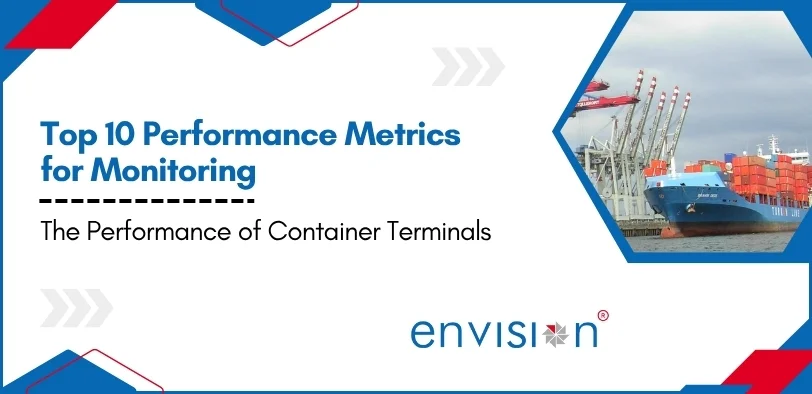
Table of Contents
1. Introduction
2. Turnaround Time (TAT)
3. Berth Productivity
4. Container Moves per Hour
5. Yard Utilization
6. Gate Moves per Hour
7. Equipment Utilization Rate
8. Dwell Time
9. On-Time Arrival and Departure
10. Cargo Damage Rate
11. Customer Satisfaction Index
12. Statistical Facts and Industry Benchmarks
13. Conclusion: Optimizing Terminal Performance with Envision's Smart Solutions
Introduction
Container terminals are essential nodes in the global supply chain, serving as cargo transfer sites between marine and land transportation. Their efficiency and efficacy are critical to the smooth movement of trade and goods across the world. In this article, we will look at the top ten performance measures for container terminals. These indicators are useful not just for analysing current performance, but also for guiding improvements and strategic planning.
1. Turnaround Time(TAT)
Turnaround time is the duration that required for a ship to complete its operations at the terminal. It's an important indicator of efficiency. The faster a ship is turned around, the sooner it can return to sea, saving idle time. World-class ports frequently aim for a TAT of less than 24 hours for big cargo ships.
2. Berth Productivity
Berth productivity refers to the number of containers moved per hour when a ship is at the berth. High productivity reduces the time ships spend waiting at the port, resulting in increased throughput. Top terminals frequently reach more than 30 movements per hour per crane.
3. Container Moves per Hour
This metric is linked to berth productivity but focuses on total container movement through the port. It measures the terminal's operating efficiency and equipment efficacy.
4. Yard Utilization
Yard utilization is defined as the percentage of terminal yard space that is used. Optimal utilisation guarantees sufficient capacity for arriving and leaving containers without producing congestion or delays.
5. Gate Moves per Hour
This metric counts the number of containers passing through the terminal gates every hour. Efficient gate processing is required to avoid truck congestion and delays, which can have a cascade effect on entire terminal operations.
6. Equipment Utilization Rate
This indicator measures how efficiently the terminal's equipment (such as cranes and transport trucks) is used. Higher utilisation rates usually reflect more efficient operations.
7. Dwell Time
Dwell time refers to how long containers remain at the terminal. Reducing dwell time is crucial for freeing up yard area and increasing the terminal's throughput capacity.
8. On-Time Arriva land Departure
This metric measures the timeliness of ships arriving and departing from the terminal. Delays may interrupt the entire supply chain; hence this is an important performance measure.
9. Cargo Damage Rate
The rate of cargo damage is a quality metric. It demonstrates the terminal's competence to handle cargo safely and securely. Lower damage rates indicate better operational handling.
10. Customer Satisfaction Index
Although more subjective, this statistic is critical. It assesses the satisfaction of shipping lines, transportation businesses, and other stakeholders with the terminal's services. High customer satisfaction is frequently an accurate predictor of overall performance excellence.
Statistical Facts and Industry Benchmarks
- According to the Journal of Commerce, major Asian terminals, notably in China and Singapore, typically achieve berth productivity of more over 35 movements per hour.
- World Bank research found that enhanced automation might cut container stay times by up to35%.
- According to research, the top-performing container ports have equipment utilisation rates of around 70-80%.
- The Port of Rotterdam is noted for its efficiency, with an average container stay period of less than 48 hours.
- According to customer satisfaction studies conducted by renowned marine consultancies, dependability and efficiency are the most important aspects that influence customer satisfaction in terminal operations.
Conclusion: Optimizing Terminal Performance with Envision's Smart Solutions
Tracking key performance indicators enables container terminals to pinpoint inefficiencies, refine strategies, and maintain a competitive edge in the global logistics network. As the industry advances toward greater digitalization and automation, these metrics will continue to evolve, but their core role in assessing terminal performance remain sun changed.
Envision’s cutting-edge solutions empower businesses to navigate these shifts seamlessly, leveraging data-driven insights and automation to enhance efficiency, reduce costs, and drive sustainable growth.
Ready to transform your terminal operations?
Contact Envision today to discover how our smart solutions can optimize performance, improve ROI, and future-proof your port operations.
Talk to us today to know how our solutions can accelerate your digital transformation
Let's Talk



.webp)





.webp)
.webp)
.webp)








.webp)


%20ver1_1.webp)


.webp)
.png)
.png)