Envision
AI-Powered OCR Bulk Billing Automation: Transforming Maritime Invoicing
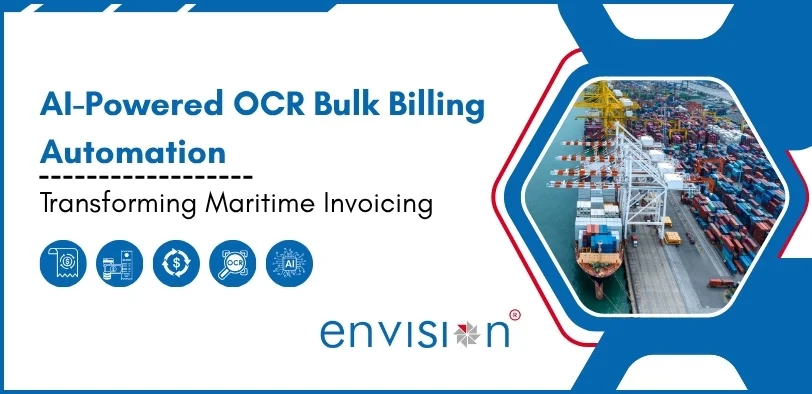
Table of Contents
1. Introduction
2. Pain Points in Maritime Billing
3. How OCR and AI Work Together
4. Key Benefits for Maritime Operations
5. ROI & Performance Metrics
6. Integration with Existing Systems
7. Security & Compliance
8. Conclusion
Introduction
Financial transactions are complex as the logistics are complex in the maritime industry. The terminals, shipping lines, freight forwarders and service providers all interface with various systems where invoices, bills of lading, and a ton of paperwork are being generated daily. Conventional methods of billing usually entail hand-writing of data, multi-level approvals, and document cross-checking a process that is not only time consuming but also one that is highly error prone. As an operator in the maritime industry, the need to enhance efficiency and minimize overheads in operations has seen Optical Character Recognition (OCR) and Artificial Intelligence (AI) through bulk billing automation become a game-changer.
This blog will discuss the role of OCR and AI in changing maritime invoicing, the pain points, the technology processes, practical advantages, the proper performance indicators, integration plans, and the compliance factor.
Pain Points in Maritime Billing
Before diving into automation, it is essential to understand the challenges in maritime operations face with billing:
1.Manual Data Entry and Errors: The majority of terminals and shipping lines continue to use manual operations in capturing invoice data on different documents. Thousands of invoices are created every month, it is only natural that human error may occur-a wrong digit, erroneous vessel reference, and wrong billing code may lead to conflicts, late payments, and relationships with clients that are not so good.
2.High Operational Costs: Paper based billing involves a lot of human resource. Employees have to balance shipments, check data of cargo and to handle approvals. These mechanisms are quite time and cost consuming that impact the overall operational efficiency.
3.Slow Processing Times: Traditional invoicing can take days or even weeks. Every verification step—checking rates, matching shipment records, approving manager signatures—delays payment cycles and impacts cash flow.
4.Limited Visibility and Reporting: In the absence of automation, maritime operators have difficulties in creating real-time information about invoicing status, outstanding payments, or billing accuracy. This invisibility can also hamper the financial planning and operations.
5.Complex Document Formats: Invoices related to maritime are provided in many different formats such as PDFs, scans, emails, and in some cases, notes that are written by hand. The multiplicity of forms makes it more challenging to extract data and more likely to make mistakes.
All these issues combined point to the necessity of the effective, smart system that would be able to perform high-volume invoicing with precision and speed. Here, OCR and AI come to the rescue to rethink the processes of maritime billing.
How OCR and AI Work Together
Bulk billing automation combines the synergistic capabilities of OCR and AI and turns the traditional invoicing process into a smooth, smart task.
Optical Character Recognition (OCR): OCR is a technology that is used to convert various kinds of documents such as scanned paper, PDF files, or digital images into machine readable text. In the case of maritime billing, it is possible to automatically identify the corresponding fields of invoice numbers, vessel names, container IDs, port charges, and due dates. The OCR process eradicates manual input that is associated with unstructured data, there by minimizing errors and also saves time.
Artificial Intelligence (AI): Whereas OCR is used to derive raw data, AI is used to provide intelligence. AI algorithms may be used to authenticate extracted data against already existing records, identify anomalies, classify charges and even anticipate the possibility of discrepancies. By learning the past billing patterns and exceptions, machine learning models keep on improving in terms of accuracy. As an example, AI maybe able to alert about an invoice in which port charges are suspiciously high or a discrepancy between cargo manifests and billing information.
Integration of OCR and AI: OCR and AI can work together to create the real power of automation. The first step of the extraction is done by OCR, which involves processing of paper-based or PDF invoices into structured data. This information is then processed by AI and confirmed, charges are categorized, and invoices are directed towards approvals or payments. This ensures that not only the processing is done faster but also there is an intelligent decision-making in each stage of the billing cycle.
Key Benefits for Maritime Operations
Implementing OCR and AI-driven bulk billing automation brings tangible advantages across multiple dimensions of maritime operations.
1.Enhanced Accuracy: The use of automated extraction and verifications saves huge errors by humans. Invoices are verified with historical data and contracts and shipping records and each billing record is correct. A reduction in the number of errors will translate to a reduction in conflicts and unpaid bills, and this will eventually enhance client satisfaction.
2.Accelerated Processing: Removing the process of manual entry and automation of verification, invoices that before can only be processed in days are now able to be processed in hours or even minutes. The quicker billing is better in the cash flow, where the maritime operators can reinvest in their operations faster.
3.Cost Efficiency: By decreasing the number of manual workers, operational costs are also cut. The employees will be able to dedicate their time to other more valuable activities, including customer relationship management, financial analysis, and optimization of operations rather than data entry.
4.Real-Time Visibility: Automated systems also give dashboards and analytics which monitor the status of every invoice. The operators of the maritime have an opportunity to see instantly the account invoices that are pending, accepted, challenged or paid and get insights on making better decisions.
5.Scalability: OCR and AI systems have high scalabilities, whereby they can support an increase in the number of invoices without similar growth in human resources. The automation system is able to operate additional invoices without operational bottlenecks as the shipping activity increases.
6.Improved Compliance: Automation is a way to make sure that invoices meet all the contractual conditions, port rules, and international accounting standards. By embedding validation rules and audit trails, OCR and AI reduce the risk of regulatory penalties or compliance breaches.
ROI & Performance Metrics
Investing in bulk billing automation is not only a strategic decision but also a measurable one. Maritime operators can track the return on investment (ROI) through several performance metrics:
1.Processing Time Reduction: One of the important metrics is how long it takes to process an invoice after it has been received to the time it has been paid. This time can be reduced by 50%-80% percent due to automation leaving staff with other important activities.
2.Error Rate Reduction: The operators are able to quantify improvements in the accuracy of billing by comparing the error rates before and after automation. The reduction in errors will result in fewer conflicts and a decrease in the workload of the administration.
3.Cost Savings: One way of quantifying labor cost savings due to less manual entry and verification is in monetary terms. Furthermore, quicker processing of invoices has a positive effect on the cash flow and minimizes financing expenses.
4.Productivity Gains: The productivity of staff can be evaluated on an invoice count before automation and after automation. With AI-driven systems, the same team can work on increased volumes efficiently.
5.Compliance Metrics: Supervision of compliance with regulatory and contractual standards provides information on the efficiency of automated validation processes. Less risk of compliance will be a form of indirect financial savings and reputation protection of the company.
ROI in bulk billing automation is there fore a combination of time saved, errors reduced, cost efficiency, and compliance improvements. Maritime companies that adopt these systems often see significant financial and operational gains within the first year.
Integration with Existing Systems
To be effective, automation has to be integrated to work with the current maritime systems like the Terminal Operating Systems (TOS), Enterprise Resource Planning (ERP) systems and Customer Relationship Management (CRM) systems.
Terminal Operating Systems (TOS): through linking automated billing systems to TOS service providers are guaranteed that invoicing operations present real-time cargo operation, container handling fee, and service fees. The shipping logs and operational records are auto-retrieved with integration, and the discrepancy between financial records and physical operations is done away with.
ERP Systems: The automation of billing coupled with ERP systems allows the accounting systems, general ledger updating, and financial reporting to be efficient. The automated workflows coordinate the data across departments to make sure that the finance departments receive correct and timely data to make budgets and conduct analyses.
CRM Platforms: CRM systems can be integrated with the operators to monitor customer-related billing regulations, discounts, and contractual agreements. The automatic application of the terms with recurring clients or warning the staff in case of exceptions can be used by AI to improve the customer service and relationships management.
Connection API: The current OCR and AI applications are API friendly, which enables communications between the systems that are not related easily. This is to make sure that automation is used in complement of the existing infrastructure and not disruptive to them, hence deployment is quick and cheaper.
Modular Implementation: Operators can begin with the most important types of invoices or with high-volume customers and automate all of their billing processes. This gradual process has reduced risk of operations and maximized the benefits in the initial stages.
Proper integration also means that automation is effective in the operational ecosystem of the maritime organization and generates accurate, timely, and actionable billing insights.
Security & Compliance
Dealing with financial information in the maritime industry should involve high-security and compliance standards. The automated billing systems need to be able to satisfy such requirements in order to safeguard sensitive information and adhere to regulations.
Data Security: OCR and AI systems store and run sensitive invoice data, which can be customer data, bank data, or transactional data. To avoid unauthorized access, encryption, secure access controls, and data anonymization techniques should be used.
Audit Trails: Automated systems would generate detailed logs of all transactions involved in the processing of invoices. These tracks keep record of the individuals who accessed the information, any changes done to the information, and the chain of approvals, which would stand up internal audits as well as regulatory audits.
Regulatory Compliance: Maritime: Marine operations have to comply with the global financial reporting standards (IFRS), taxation, and billing in ports. These rules can be automatically put into force by AI and will decrease the chances of non-adherence.
Fraud Prevention: AI can identify anomalies in billing, including duplicate payments, suspicious payments, or unexpected payments. The early detection will reduce financial loss and enhance operational integrity.
Data Retention and Privacy: Automation systems should bein line with data retention policies and data protection laws including GDPR. Good archival, secure deletion, and controlled access is compliant and efficient in operation.
Incorporating protection and compliance in the automation system, the maritime operators secure their financial soundness, preserve the confidence of clients, and reduce the operational risks.
Conclusion
OCR-based and AI-based bulk billing can make maritime billing a thing of the past due to its manual and error-laden nature, and turn it into an automated, intelligent system. Addressing those typical areas of concern, including slow processes, human mistakes, and high cost of operation, these technologies can help the maritime operators to become more accurate and fast with the cash flow, cut expenses, and improve compliance.
OCR data-extraction and AI-based intelligent verification make sure that all invoices are done fast and correctly. Automated systems bring real time visibility, scalability and actionable insights, enabling finance departments to concentrate on strategic decision making and not on administration. Automation is an extension of operational processes when connected to the already existing TOS, ERP, and CRM systems and makes the process more productive without disrupting the existing operational processes.
Automation of bulk billing is not merely a technological upgrade, a strategic decision that can give concrete ROI. Couples of maritime operators reduce the time of handling invoices, cut the number of mistakes, improve the level of compliance, and boost security which allows them to set a new standard of efficiency and competitiveness in a more complicated industry.
OCR-based and AI-based automation of billing is no longer an option it is a necessity to terminals, shipping lines, and service providers who aim to achieve operational excellence. Maritime finance in the future is to be intelligent, fast, and accurate, and automation is spearheading the process.
Get the best out of your maritime operations using Envision Billing and Invoice Management. Automate mass invoicing, remove mistakes, and speed up cash flow using AI precision. Ensure Compliance, achieve real-time visibility and liberate your teams to concentrate on strategic development rather than manual work.
Want to know more? Contact us today or drop us an email to connect with our experts and discover how your maritime billing can be smarter, faster, and more efficient.
Talk to us today to know how our solutions can accelerate your digital transformation
Let's Talk

.webp)


.webp)
.webp)
.webp)


.webp)


%20ver1_1.webp)


.webp)
.png)
.png)