Envision
How AI-Driven Depot Management Systems Are Redefining Operational Efficiency
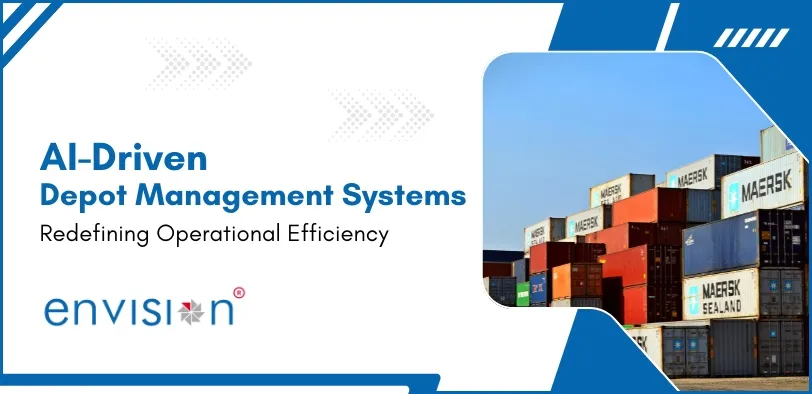
Table of Content
1. Introduction
2. The Evolution of Depot Management
3. What Is an AI-Driven Depot Management System?
4. How AI Enhances Operational Efficiency
5. Technical Architecture of AI-Driven Depot Management Systems
6. AI Applications in Depot Operations: Real-World Examples
7. Strategic Benefits
8. Challenges and Considerations
9. Best Practices for Implementing AI-Driven DMS
10. The Future of AI-Driven Depots
11. Envision Depot Management System: Driving Intelligent, AI-Enabled Depot Operations
12. Conclusion
Introduction
Operational efficiency is no longer a luxury in the ever-competitive industrial environment today, but a strategic requirement. A depot, which is the nerve center of inventory management, logistics coordination, and maintenance of assets, increasingly becomes complicated. Conventional methods of depot management based on manual operations, disaggregated data and reactive decisions are no longer satisfactory. Introduce AI-driven Depot Management Systems(DMS)-technologically modernized system to transform depot operations that uses artificial intelligence, machine learning, and predictive analytics.
This blog discusses the ways in which AI-driven DMS transforms operational efficiency with a pro-found understanding of its technical workings, real-life uses, andthe strategic value to both executives and researchers.
The Evolution of Depot Management
Traditionally, depot management used to pre-suppose the large amount of manual tracking of inventory, scheduling, and maintenance operations. The logs were created in paper form and the siloing of software applications had led to inefficiencies, high error rates and slow decision making. These conventional practices were no longer suitable as supply chains became more global and multi-faceted to satisfy demands of speed, accuracy and scalability.
The emergence of Enterprise Resource Planning (ERP) and simple Depot Management Systems was the first relief, and it offered digital documentation and rationalized workflow. Nevertheless, these systems were usually not as effective in responding to predictive requirements, optimizing resource distribution, and delivering actionable intelligence.
The following stage of the evolution of depot operations is AI-based systems that utilize big data, real-time analytics, and smart automation to achieve operational excellence. These systems go beyond recording and reporting to forecasting operational requirements, decision-making, and the reduction of in-efficiencies throughout the depot ecosystem.
What Is an AI-Driven Depot ManagementSystem?
AI-based Depot Management System (DMS) refers to a software platform, which combines artificial intelligence, machine learning algorithms, and advanced analytics to control and optimize depot processes. In contrast to traditional systems where only the records and reports are made, AI-driven DMS is predictive, recommends, and automates the decision-making process. The most important functionalities are:
Predictive Maintenance - AI works in the predictive maintenance, the algorithms examine the past performance and usage of assets to predict failures before they happen and minimise downtime and maintenance expenses.
Intelligent Inventory Management - Intelligent machine learning forecasts would be used to predict stock needs, optimize reorder points, and stop overstock and stockouts.
Scheduling Resources Automation - AI will use workforce, vehicle movement, and equipment utilization based on operational priorities and real-time constraints.
Operational Analytics - Advanced analytics offer feasible details on depot performance, bottlenecks, and performance indices.
Process Automation - Robotic process automation (RPA) is an automation that combineswith AI to carry out administrative processes repetitively to increase speedand accuracy.
Intelligence permeates the depot operations by enabling AI-based DMS to make depots more active data-driven centers, able to react dynamically to operational demanding issues and strategic objectives.
How AI Enhances Operational Efficiency
The efficiency of the work of AI-based depot management systems is enhanced on several levels:
1. Foresight Maintenance to Minimize Downtime
Costs on maintenance and unexpected equipment failure form a major contributor to lack of efficiency in it's operations. Conventional methods utilize planned maintenance or reactive maintenance which tend to cause too much unproductive downtime or un-warranted servicing.
AI-based DMS uses predictive maintenance algorithms to monitor sensor data in real-time, repair history, and patterns of use. These algorithms recognize the signs of wear on the equipment early enough and hence preemptive maintenance. Benefits include:
- Cutting on the un-expected downtime up to 30-40%.
- Asset-based maintenance schedules are optimized, rather than random.
- Pro-longed lifecycle of high value equipment.
Predictive maintenance leads to improved efficiency directly by reducing disruptions and continuing operation. Also, automated procurement systems can be connected with predictive insights to pre-order the key spare parts, which will cut down the number of delays.
2. Machine Learning Inventory Optimization
Depot inventory management is an art. Stocks occupy capital and space, where as stockouts interfere with operations. AI-based DMS is based on machine learning models to interpret the historical demand and seasonality, lead times, and supplier performance and creates:
- The best reorder points of each SKU.
- Accuracy levels of the forecasted inventory levels greater than 90%.
- Suggestions of stock allocation in dynamic locations among depots.
What is obtained is a just-in-time inventory policy which minimizes carrying costs and ensures the availability of important materials. Other sophisticated systems have gone as far as to use re-inforcement learning algorithms to evolve inventory policy dynamically when ever demand patterns or supplier variability changes.
3. Smart Resource Assessment
The proper use of human resources, equipment and trucks is essential in the depots, especially those with large cargo amounts or intricate logistics.
AI-based DMSuses optimization methods and real-time operations data to:
- Assign staffbased on capacity, work and shift.
- Optimize route vehicles to minimize the travel time, fuel use and emissions.
- Rank the tasks in terms of business impact and urgency in the operations.
Organizations gain a lot in terms of operational efficiency by reducing the time wasted and maximizing the production throughput. Workforce management applications based on AI can increase productivity by 20-30% and be applied to high-volume depots without violating labor regulations.
4. Real-time Operational Visibility
Dashboards are the AI-driven programs that integrate the data collected by the IoT sensors, ERP, and the operational logs into real-time visualizations.
The decision-makers would have immediate understanding of:
- Asset utilization rates
- Workflow bottlenecks
- Anticipatory risk notifications and functions KPI's
This visibility will enable the executives to anticipate such disruptions, handle contingencies, and keep on enhancing the performance of depots. Mobile integration stretches field supervisors and operating teams to have equal empowerment by real-time insights.
5. Process Automation and Streamlining
AI-based DMS will incorporate Robotic Process Automation (RPA) to process monotonousadministrative jobs like:
- Updating inventory logs
- Production of compliance reports
- Handling suppliers invoices and purchase orders
These processes are automated to minimize human error, release personnel to do strategic work and increase the speed of depot work. With time, automation of processes also provides a data-rich environment, which enhances the accuracy of AI models and the efficiency of decision-making.
Technical Architecture of AI-Driven Depot Management Systems
The knowledge of the underlying architecture can make executives and researchers value the way AI can provide these efficiencies. An intelligent DMS based on AIincludes:
Data Layer - Consolidates structured and unstructured data of sensors of the IoT, ERP, maintenance record, and external data.
Integration Layer - links the DMS to the existing enterprise systems through APIs, which provides a smooth exchange of data.
AI &Analytics Layer - Engines Predictive algorithms, machine learning models, and optimization engines process data and come up with actionable insights.
Application Layer - It includes user interfaces and dashboards along with automation workflows that are specific to various operational roles.
Security and Compliance Layer - This provides data integrity, control of access and compliance with industry regulations.
This scalable framework enables depots to add AI functionality bit by bit, hook up with existing systems, and have solid data management. Sophisticated applications also feature edge AI where the decisions are taken locally on IoT devices in real-time, which minimizes the latency and enhances responsiveness.
AI Applications in Depot Operations:Real-World Examples
Case Study 1: Rail Depot Predictive Maintenance
One of the major rail stations incorporated AI-based DMS to track wagons and locomotives.Vibration, temperature and wear patterns were scanned by sensors. Machine learning systems forecasted component failures, which minimized non-planned downtime by 35 and a service loss of 20.
Case Study 2: Industrial Depot Inventory Optimization
A depot of industrial equipment applied the concept of AI based demand forecasting. The system was used to examine past consumption, supplier lead times and seasonal changes. Stockouts were reduced by 40 percent and the cost of holding inventory has been reduced by 25 percent proving the direct ROI of AI-driven optimization.
Case Study 3: Automated Vehicle Routing in Depots of Logistics
An example of logistics depot that uses AI as the means of optimizing vehicle routing involved thousands of daily deliveries. Planning of the routes included real-time data of traffic, shipment priorities, and vehicle capacity. The efficiency of the delivery increased by 30% and the fuel expenses decreased by 15% which testifies to the effect of AI on operational efficiency.
Case Study 4: Automotive Depot Workforce Scheduling
A car parts warehouse introduced AI-based scheduling of workforce. Machine learning models were used to evaluate the skills, availability, and complexity of the tasks per worker to develop a dynamic roster. The efficiency of operations increased by 22 percent, the overtime expenses were decreased by 18 percent, and it resulted in the increase in employee satisfaction because every schedule was predictable.
Strategic Benefits for C-Level Executives
Strategic benefits of AI-driven depot management systems are not limited to operational benefits to executives considering it:
Cost Efficiency - Predictive maintenance, inventory optimization, and automated workflows lower operation costs.
Scalability - AI allows depots to manage more volumes without corresponding increases in either workforce or infrastructure.
Responsiveness - Agility of decisions-Real-time analytics enable executives to be proactive inreaction to disruptions or variations in demand.
Sustainability - Efficient resource use and predictive operations will cut energy use and carbon footprint.
Competitive Advantage - AI-based depots have lower turnaround time, increased precision, and enhanced customer satisfaction, which acts as a visible distinguishing factor in the market.
AI-driven DMS is now not only an operational option to consider but a strategic business endeavor, directly affecting the profitability and market position.
Challenges and Considerations
Although AI-based depot management systems have many advantages, their implementation is associated with the following challenges:
Data Qualityand Availability - AI models demand accurate, clean, and complete data. Inaccurate data may affect predictions.
Integration with Legacy Systems - The current ERP or depot software can need to be customized to integrate well with AI.
Change Management - Adoption of AI-driven processes by the workforce is a process that should be supported by training, cultural alignment and leadership.
Cyber security - Inter connection between various systems and IoT devices pre-disposes them to cyber-attacks.
The mitigation of these difficulties will include a well-planned implementation strategy, data governance, and constant observation of the work of AI models.
Best Practices for ImplementingAI-Driven DMS
In order to achieve the highest ROI and operational efficiency level, companies must address the following best practices:
Begin with High-Impact Areas -Begin with areas of predictive maintenance or inventory optimization where ROI is instant.
Prepare Data– Prepared and organized data of a high quality is the key to successful AI performance.
Use Cloud and IoT - Cloud systems can be scaled, and IoT gadgets will be able to give real-time operational data.
Participate in Cross-Functional Teams - To implement it successfully, IT, operations, and management should collaborate.
Monitor and Iterate - AI models need a constant process of monitoring, retraining, and optimization to adjust to the current dynamics of operation.
The adherence to these practices can guarantee that AI-driven depot management is not a simple technical update but a strategic change.
The Future of AI-Driven Depots
The autonomous depots, where AI coordinates the operations across the entire frame,will become the next step in the history of depot management. The emerging technologies are:
Digital twins Digital models of depots in real time simulated, scenario-planned, predictive decision-making.
High-tech Robotics AI-powered cargo robots, less human-intervention, more security.
Cognitive AI–The systems that have the ability to process unstructured information, likemaintenance manuals or operator notes, and give intelligent advice.
Blockchain Integration Secure, and immutable records of data to track an asset, supplychain transparency, and compliance reporting.
To C-level executives and researchers, such developments are an indication of campaign change between reactive operational management and anticipation and fully optimised depot ecosystems.
Envision Depot Management System: Intelligent, AI Driven Depot Operations
As companies switch to an AI-based depot eco-system, the performance of the changes is largely determined by the strength, scalability, and smartness of the depot management platform. The Envision Depot Management System is specifically customized to meet the operational, analytical and strategic needs of the contemporary depots that operate within an asset and logistics-intensive environment.
The depot management at envision is not just a simple digitalization. The platform is set to be an AI-ready, data centric system system that combines operational processes, asset intelligence and predictive analytics into a single operational platform. This allows the depots to deviate the passive execution to pro-active and insight-driven decision-making.
Why Envision Depot Management System Is Important to the Modern Depots
Modern depots are forced to deal with the growing complexity of assets, rising demands at service level, regulatory requirements, and cost issues at the same time. Envision helps to overcome all these challenges by allowing:
- Single view of operations on assets, inventory, human resources and flows.
- The data intelligence-based predictive and condition-driven maintenance strategies.
- Scalable architecture with the ability of supporting multi-depot, multi-location operations.
- Integration with business systems like ERP, EAM and analytics systems.
Operational execution and strategic intelligence match at Envision as it enables the leadership team to maximize performance without violating governance and control.
Major Characteristics of Envision Depot Management System
The Envision Depot Management System offers a set of features that are aimed at operational excellence:
AI-Enabled Asset and Maintenance Management
Prescriptive maintenance, asset health and lifecycle optimization using historical and real-time data are possible.
Advanced Inventory Optimization and Spare parts optimization
Enhances accuracy of inventories, lowers carrying costs and the availability of the critical spares by forecasting demand through smart replenishment.
Integrated Workflow Automation
Automates the depot processes such as inspections, repairs, approvals and compliance reporting eliminates manual intervention and errors.
Real-Time Operational Dashboards and Analytics
Gives executives and operations staff KPI-based performance monitoring, risk-detection, and strategic plans.
Enterprise Grade Security and Compliance
Provides data integrity, access control, audit ready and regulatory compliance throughout depot operations.
These capabilities allow Envision to set depot management as a strategic performance driver that would help organizations become more efficient, reliable, and resilient in the long term.
Conclusion
AI-based depot management solutions have become a hallmark in the digitization of asset intensive and logistics intensive processes. Incorporating predictive analytics, machine learning, automation and real-time intelligence into primaryp rocesses within the depot, organizations are essentially transforming the manner in which they maintain assets, manage inventory and make operational decisions. Most importantly, what used to be a reactive and labor-intensive aspect is swiftly developing into a predictive, data-driven, and strategically aligned operational field.
The real worth of AI-based depot management as has been observed in this blog is not in the efficiencies it will bring, but in that it will provide operational foresight, resiliency, and scalability. In the case of C-level executives, it can be translated into quantifiable downtime savings, capital optimization, better service availability, and greater governance of intricate depot ecosystems. To researchers, AI-driven DMS is an advanced application field where predictive models, optimization methods, and intelligent automation intersect to address real-world operational issues in large-scale solution to a problem.
In this scenery, solutions like the Envision Depot Management System demonstrate how AI-capable architectures, built-in analytics, and enterprise-caliber design may bring these capabilities to bear in a systematized and enduring way.
Such systems have the potential to drive organizational performance by integrating asset intelligence, inventory optimization, workflow automation, and real-timevisibility into a single operational environment, there by leaving improving performance in small steps behind and into ongoing performance optimization.
The integration of AI-based depot management is no longer a discretionary technology effort as industrial settings continue to become increasingly inter dependent, and operational complexity continues to increase, making it a strategic necessity. Companies that make smart, scalable investments in depot management software will be in a better place to handle uncertainty, maintain operational excellence, and become leaders in the new era of intelligent logistics and digitally optimally depot operations.
Book an executive demo or speak with Envision’s solution specialists to understand how an AI-driven depot management platform can directly impact operational resilience, cost efficiency, and long-term competitive advantage.
Talk to us today to know how our solutions can accelerate your digital transformation
Let's Talk

.webp)


.webp)
.webp)
.webp)




.webp)


%20ver1_1.webp)


.webp)
.png)
.png)