Envision
What Does a Vessel Planner Do? Roles, Responsibilities and Vessel Planning Explained
Table of Content
1. Introduction
2. What Is Vessel Planning?
3. What Does a Vessel Planner Do?
4. How Does Vessel Planning Work in a Container Terminal?
5. Key Performance Indicators (KPIs) in Vessel Planning
6. Common Challenges in Vessel Planning
7. How Digital Technology Is Transforming Vessel Planning
8. How Envision Enterprise Solutions Supports Smarter Vessel and Terminal Operations
9. Conclusion: The Future of Vessel Planning in Smart Container Terminals
Introduction
Vessel planning is one of the most critical functions in container terminal operations. Every container loaded onto or discharged from a vessel must be handled according to a carefully coordinated plan that considers cargo requirements, vessel capacity, container positioning, crane allocation, and terminal resources. Behind this complex process is the vessel planner, a key operational professional responsible for translating cargo information and vessel requirements into an executable vessel operations plan.
From preparing vessel stowage plans and coordinating container movements to optimizing quay crane utilization and managing operational changes, vessel planners play an important role in ensuring efficient vessel operations. Their decisions directly influence vessel turnaround time, terminal productivity, cargo handling efficiency, and overall operational performance.
As container vessels increase in size and terminal operations become more complex, vessel planning increasingly depends on accurate operational data, effective coordination, and integrated digital systems.
In this article, we explore what a vessel planner does, their key responsibilities, how vessel planning works, the challenges involved, and how digital technologies are transforming vessel planning in modern container terminals.
What Is Vessel Planning?
Vessel planning is the process of organizing and coordinating container loading and discharge operations on a container vessel. It involves determining where containers should be positioned, the sequence in which they should be loaded or discharged, and how vessel and terminal resources should be coordinated to complete operations efficiently.
A vessel planning process considers several operational and technical factors, including:
- Vessel specifications, capacity, and stowage configuration.
- Container dimensions, weights, and cargo classifications.
- Loading and discharge requirements across different port calls.
- Vessel stability, stack-weight limitations, and lashing requirements.
- Quay crane allocation and operational sequencing.
- Yard container availability and internal transportation requirements.
- Special cargo requirements, including reefer, dangerous goods, and out-of-gauge containers.
The primary objective is to develop a safe, operationally feasible, and efficient vessel plan that supports smooth cargo handling while minimizing unnecessary container movements, operational conflicts, and vessel delays.
What Does a Vessel Planner Do?
A vessel planner is responsible for preparing, coordinating, and managing the stowage and operational plans required for container vessel loading and discharge activities.
The role begins before a vessel arrives at the terminal and continues throughout its port stay. Vessel planners work with shipping lines, vessel officers, yard planners, berth planners, and terminal operations teams to ensure that all vessel-related activities are properly coordinated.
Their responsibilities extend beyond assigning container positions. They must understand vessel configurations, cargo information, terminal capabilities, equipment availability, and operational constraints to develop a plan that can be executed safely and efficiently.
1. Vessel Stowage Planning
One of the primary responsibilities of a vessel planner is preparing the vessel stowage plan.
A stowage plan identifies the exact position of each container on board the vessel using its bay, row, and tier coordinates. The planner considers container dimensions, weight, destination, cargo characteristics, and vessel-specific restrictions before assigning container positions.
Effective stowage planning helps:
- Optimize available vessel capacity.
- Maintain appropriate weight distribution.
- Respect stack-weight and lashing limitations.
- Position containers according to port rotation.
- Minimize unnecessary container shifting and restow movements.
- Support efficient loading and discharge sequences.
A well-prepared stowage plan provides the foundation for coordinated vessel operations.
2. Pre-Arrival Vessel Planning
Vessel planning begins well before a vessel reaches the berth. Pre-arrival preparation allows terminal teams to review cargo information, identify potential discrepancies, and organize resources ahead of vessel arrival.
The vessel planner receives and reviews information from the shipping line, including vessel schedules, discharge lists, inbound stowage information, and export loading requirements.
A key data exchange message used in this process is BAPLIE, which communicates vessel bay and container stowage information. Other messages, such as COPRAR, support the exchange of container loading and discharge orders.
During pre-arrival planning, vessel planners typically:
- Review inbound vessel stowage information.
- Verify discharge requirements and container details.
- Check export container availability in the yard.
- Identify missing containers and data discrepancies.
- Review special cargo requirements.
- Coordinate with yard and berth planning teams.
- Prepare preliminary loading and discharge sequences.
Identifying discrepancies before vessel arrival helps reduce last-minute changes and supports better operational readiness.
3. Container Loading and Discharge Planning
Vessel planners determine how containers should be loaded onto and discharged from the vessel.
The loading and discharge sequence must account for container destinations, vessel configuration, cargo priorities, and the order of port calls.
For example, containers intended for the next port of call should generally be positioned to allow efficient discharge without unnecessary shifting of containers destined for later ports.
Similarly, export containers must be positioned according to their discharge destinations and applicable vessel stowage restrictions.
Effective loading and discharge planning helps reduce rehandling, avoid operational bottlenecks, and maintain a consistent flow of container movements between the vessel and terminal yard.
4. Quay Crane Allocation and Coordination
Quay cranes are among the most important resources in container vessel operations. Their allocation and workload distribution directly influence vessel handling productivity and turnaround time.
Vessel planners coordinate with berth and equipment planning teams to support the allocation of quay cranes across vessel bays and work sequences.
This involves considering:
- Container move volumes across different vessel bays.
- Crane availability and operating capacity.
- Hatch-cover opening and closing requirements.
- Crane interference and operational safety restrictions.
- Yard readiness and container delivery sequences.
- Expected crane productivity and vessel completion targets.
Balanced crane workload distribution helps reduce equipment idle time and improve overall vessel handling efficiency.
The objective is not simply to deploy more cranes, but to ensure that available cranes can work productively without unnecessary interference or delays.
5. Special Cargo Planning
Special cargo requires additional attention during vessel planning because of specific handling, safety, and stowage requirements.
Three important cargo categories include:
Reefer Containers
Reefer containers carry temperature-sensitive cargo and require access to suitable electrical connections and monitoring arrangements. Vessel planners must allocate appropriate reefer positions while considering vessel electrical capacity and terminal-side handling requirements.
Dangerous Goods (DG)
Dangerous goods require compliance with applicable International Maritime Dangerous Goods (IMDG) Code requirements and vessel-specific stowage and segregation restrictions. Planners must ensure that incompatible cargo is not positioned in prohibited locations or combinations.
Out-of-Gauge (OOG) Containers
Out-of-gauge containers exceed standard container dimensions and require special stowage and handling arrangements. Their positioning must account for available clearances, adjacent container positions, lifting requirements, and vessel-specific restrictions.
Accurate identification and planning of special cargo are essential for safe and compliant vessel operations.
6. Real-Time Vessel Plan Monitoring and Adjustments
Once vessel operations begin, actual terminal conditions may differ from the original plan.
Equipment breakdowns, container damage, late export arrivals, changes in cargo availability, and operational disruptions can require adjustments to the vessel plan.
The vessel planner must evaluate these changes and coordinate the necessary revisions with relevant operational teams.
This may involve:
- Revising container loading and discharge sequences.
- Reallocating container positions where operationally permissible.
- Coordinating with yard and equipment planning teams.
- Reviewing the impact of changes on vessel stability and cargo segregation.
- Communicating approved revisions to the control room and vessel officers.
- Ensuring that all operational teams work with the latest validated plan.
Maintaining an updated and coordinated vessel plan helps minimize confusion, prevent conflicting instructions, and support uninterrupted terminal operations.
7. Coordination with Yard and Terminal Operations
Vessel planning is closely connected with other terminal planning functions. A vessel plan can only be executed efficiently when the required containers, equipment, and resources are available at the right time.
The vessel planner works closely with:
- Yard Planners: Coordinate container locations, availability, and yard retrieval sequences.
- Berth Planners: Align vessel planning activities with berth schedules and expected vessel arrival and departure windows.
- Equipment and Quay Crane Planners: Coordinate crane deployment, workload distribution, and equipment availability.
- Terminal Control Room: Communicate operational sequences, monitor progress, and coordinate plan changes.
- Shipping Lines and Vessel Officers: Confirm cargo requirements, stowage arrangements, and vessel-related operational constraints.
Effective coordination between these teams ensures that vessel, yard, and equipment operations work towards a common operational plan.
How Does Vessel Planning Work in a Container Terminal?
Vessel planning follows a structured workflow that connects pre-arrival preparation, stowage planning, resource allocation, and real-time execution.
A typical vessel planning workflow includes the following stages:
Step 1: Receive Vessel and Cargo Information
The planning team receives vessel schedules, inbound stowage information, discharge lists, and export loading requirements from the shipping line.
Step 2: Review Vessel and Container Data
The planner verifies vessel specifications, container details, cargo classifications, weights, destinations, and special handling requirements.
Step 3: Prepare the Stowage Plan
Container positions are assigned based on vessel capacity, stability requirements, port rotation, and applicable stowage restrictions.
Step 4: Coordinate Yard and Crane Planning
The vessel plan is aligned with container availability, yard locations, quay crane allocation, and terminal equipment requirements.
Step 5: Validate and Finalize the Plan
The proposed plan is reviewed against relevant operational, safety, and vessel-specific constraints. Required approvals and stability verification are completed by the responsible parties.
Step 6: Execute Vessel Operations
Quay cranes, yard equipment, and terminal teams execute the approved loading and discharge sequences.
Step 7: Monitor Performance and Manage Changes
The planning team monitors actual vessel operations, coordinates necessary adjustments, and tracks progress against planned completion targets.
Following this workflow helps maintain coordination between vessel planning, yard operations, and terminal execution.
Key Performance Indicators (KPIs) in Vessel Planning
Vessel planning performance is closely associated with terminal productivity, equipment utilization, and vessel schedule adherence.
Some of the important performance indicators include:
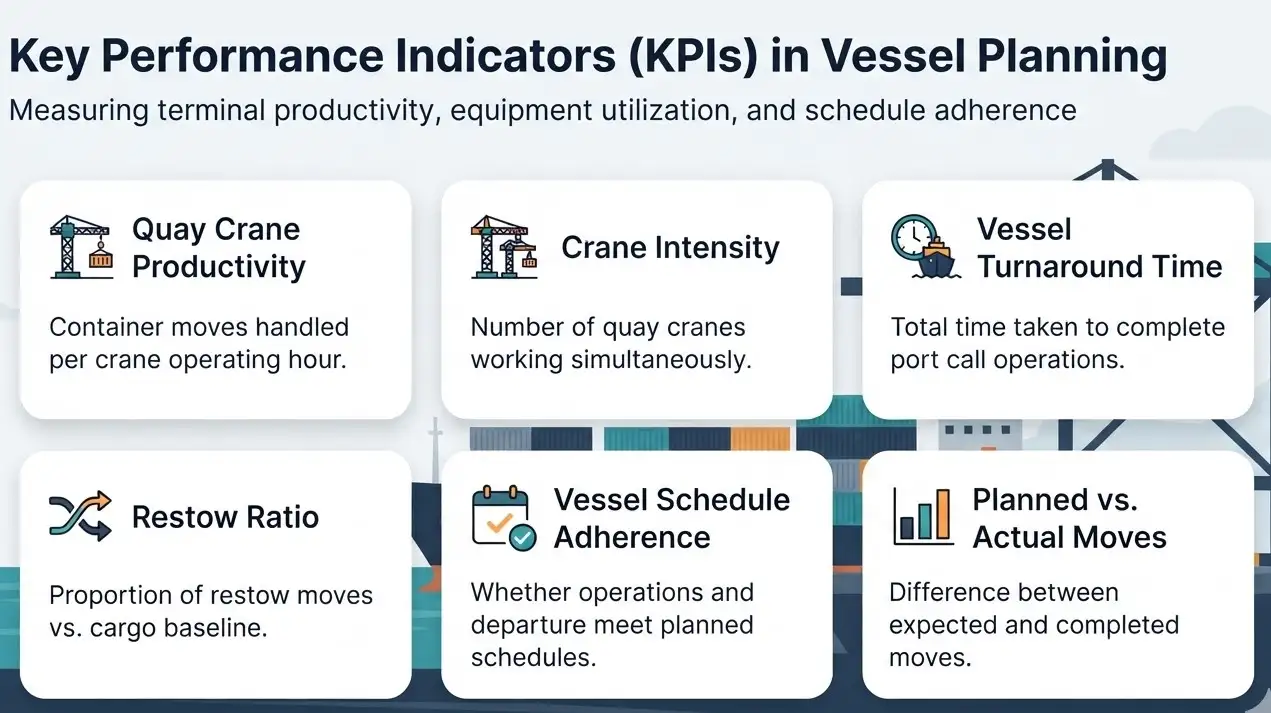
These indicators help terminal management identify operational bottlenecks, evaluate planning effectiveness, and improve resource utilization.
However, vessel performance is influenced by several factors beyond the vessel planner's control, including weather, berth availability, equipment reliability, and cargo readiness.
KPIs should therefore be interpreted in the context of overall terminal operations.
Common Challenges in Vessel Planning
Despite detailed preparation, vessel planners must deal with several operational challenges that can affect vessel productivity and turnaround time.
Inaccurate or Incomplete Container Information
Incorrect container weights, missing cargo details, and discrepancies in stowage data can create planning complications and require revisions.
Unavailability of Export Containers
Containers may not be available in their expected yard locations because of late gate-ins, documentation issues, or changes in yard operations.
Quay Crane Conflicts
Poor workload distribution, crane interference, and unexpected equipment downtime can affect vessel handling sequences and completion times.
Complex Stowage Requirements
Large vessels, multiple port rotations, dangerous goods segregation, reefer requirements, and OOG cargo introduce additional planning constraints.
Last-Minute Operational Changes
Changes in vessel schedules, cargo availability, and equipment conditions require continuous communication and timely plan updates.
Addressing these challenges requires accurate data, effective planning processes, and coordination across terminal operations.
How Digital Technology Is Transforming Vessel Planning
As container terminals handle increasing cargo volumes and larger vessels, managing vessel planning through disconnected systems and manual processes becomes increasingly challenging.
Modern Terminal Operating Systems (TOS) provide an integrated digital environment for managing vessel-related information and coordinating terminal activities.
By connecting vessel planning with yard operations, container inventory, equipment allocation, and operational execution, a TOS helps improve information visibility and coordination across the terminal.
Key digital capabilities supporting modern vessel planning include:
Integrated Vessel and Yard Planning
Connecting vessel stowage requirements with yard container locations and availability helps improve coordination between vessel and yard operations.
Automated Data Exchange
Integration with shipping line systems and electronic data interchange (EDI) messages helps streamline the exchange of vessel, cargo, loading, and discharge information.
Intelligent Planning and Optimization
AI-enabled algorithms and optimization techniques can support planning decisions by evaluating operational constraints, identifying potential conflicts, and assisting with resource allocation.
Real-Time Operational Visibility
Integrated operational information helps planning teams monitor vessel progress, identify deviations, and coordinate timely responses to operational changes.
Performance Monitoring and Analytics
Operational dashboards and performance reports help terminal management monitor crane productivity, vessel turnaround, equipment utilization, and planning performance.
Together, these capabilities help container terminals move towards more connected, data-driven, and efficient vessel operations.
How Envision Enterprise Solutions Supports Smarter Vessel and Terminal Operations
At Envision Enterprise Solutions, we understand that vessel planning is not an isolated terminal activity. It is an integral part of a connected operational ecosystem involving vessel operations, yard management, equipment coordination, and cargo movements.
Through our AI-enabled digital solutions and integrated Container Terminal Operating System (CTOS), Envision supports ports and terminals in strengthening operational coordination and improving visibility across their terminal processes.
Our technology-driven approach focuses on connecting critical operational functions, enabling better planning decisions, and supporting more efficient terminal execution.
With integrated digital capabilities, Envision helps terminals work towards:
- Connected Vessel and Yard Operations: Align vessel planning requirements with yard activities and container movements.
- Intelligent Operational Planning: Leverage data-driven planning and optimization capabilities to support better operational decisions.
- Improved Resource Coordination: Support the effective coordination of quay cranes, yard equipment, and terminal resources.
- Real-Time Operational Visibility: Improve access to operational information and support timely decision-making.
- Integrated Terminal Management: Connect key terminal processes within a unified digital operating environment.
By bringing together operational data, system integration, and intelligent digital capabilities, Envision helps ports and container terminals advance towards more efficient, coordinated, and predictable operations.
Conclusion: The Future of Vessel Planning in Smart Container Terminals
A vessel planner does much more than decide where containers should be positioned on a ship. The role connects vessel capacity, cargo requirements, stowage constraints, quay crane activities, yard operations, and terminal productivity into a coordinated operational plan.
As container shipping continues to evolve, effective vessel planning will increasingly depend on accurate information, integrated planning systems, and intelligent operational decision-making.
Modern TOS capabilities, AI-enabled optimization, and real-time operational visibility are creating new opportunities for ports and terminals to improve planning accuracy, reduce unnecessary container movements, optimize resource utilization, and strengthen vessel turnaround performance.
At Envision Enterprise Solutions, we support this transformation through AI-enabled digital solutions and integrated terminal operating capabilities designed to help ports and terminals build smarter, more connected, and more efficient operations.
Ready to Make Vessel Operations Smarter and More Efficient?
Discover how Envision Enterprise Solutions' AI-enabled digital solutions and integrated Container Terminal Operating System (CTOS) can support better vessel planning, improve vessel-yard coordination, strengthen operational visibility, and help optimize terminal performance.
Frequently Asked Questions
1. What is the main responsibility of a vessel planner?
A vessel planner prepares and coordinates vessel stowage plans, container loading and discharge sequences, and operational requirements to support safe and efficient vessel operations.
2. What is a vessel stowage plan?
A vessel stowage plan is a detailed arrangement showing the position of containers on board a vessel, organized by bay, row, and tier while considering cargo requirements, vessel stability, and port rotation.
3. What is the difference between a vessel planner and a yard planner?
A vessel planner focuses on container positioning and loading and discharge sequences on board the vessel, while a yard planner manages container locations, storage arrangements, and retrieval sequences within the terminal yard. Both roles work closely to coordinate terminal operations.
4. How does a TOS support vessel planning?
A Terminal Operating System supports vessel planning by integrating vessel schedules, container information, stowage data, yard inventory, equipment allocation, and operational execution within a connected digital environment.
5. How does AI improve vessel planning?
AI-enabled planning capabilities can help analyze operational data, identify potential conflicts, evaluate planning constraints, and support optimization of vessel and terminal resources.
Talk to us today to know how our solutions can accelerate your digital transformation
Let's Talk